



I can’t afford to grow my business
What keeps you awake at night? Read Complete Commercial Finance’s guides to some of the common challenges that many businesses face.
At the outset, a business works hard to attract and keep customers and, as its services or products grow in popularity, there often comes a point when it needs to expand. Winning a new contract can require an upgrade or investment in equipment, or perhaps you need to increase stock or wages to enable you to deliver an order but there will be a lag before you are paid for your services?
It may sound counterintuitive, but funding can help you to expand successfully. Some business owners are initially averse to borrowing, but commercial finance can be an effective tool that enables you to grow your business without putting cashflow at risk.
A business needs to pay its staff and suppliers on time, along with regular tax bills, and if cashflow is depleted by investment for a new contract, it will soon be unable to operate – a cruel irony when a growth in revenue is just on the horizon! By planning finances for the long-term, you can grow successfully, without jeopardising day-to-day operations.
Help! I've won a new contract, but can't afford to fund it
In broad terms, there are two main types of finance which can help a business to grow. If you need to purchase new equipment or machinery, asset finance allows you to borrow and finance an investment over a period of time, without taking a significant amount of cash out of the business. Read our asset finance 101 guide here.
If a new contract means you need to purchase additional stock or raw materials to complete an order, or employ more staff with increased wage costs, but anticipate a delay between fulfilling the order and receiving payment, there are a number of options which can bridge this gap, from loans to invoice discounting – read our cashflow 101 guide here.
It might be tempting to dip into reserves instead of taking on finance, but the old adage, ‘cash is king’ is a truism and having reserves to cover any unanticipated expenses will often outweigh the cost of borrowing.
How do I quote for a new contract?
Every business is different with its own individual operational costs, and while many sectors have a certain way of pricing work this too can vary hugely from region to region. Each business needs to price its products or services carefully to ensure it is able to make a true profit on a job.
A good starting point is to consider the margin you are aiming for. A top tip is to factor in the cost of any borrowing at the outset, rather than pricing a job and realising afterwards that you will need finance to fulfil the work and losing this element of your revenue. For example, if you quote a job with a 20 per cent margin, but finance subsequently costs five per cent, you will only net 15 per cent profit. It pays to speak with a commercial finance company at the earliest opportunity, to understand the finance options available to you and get a ballpark figure of costs.
It’s also important to consider the payment terms you need to offer to a prospective client. While many businesses operate with a standard 30 days between invoicing and receipt of payment, in some instances this may need to be extended to 60 or 90 days. It’s also a sad reality that many companies experience late payment – research shows that half of UK’s smaller businesses are owed £17.5bn in late payments.
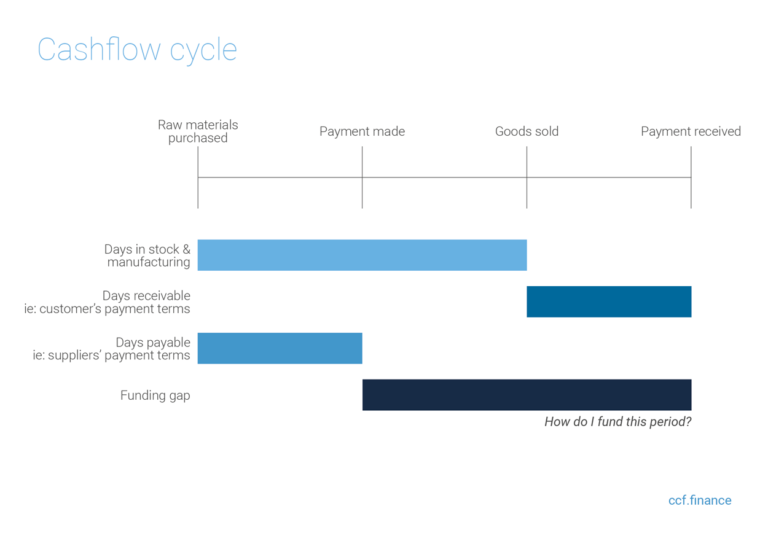
When you factor in the time between an order being placed and delivered, this can create a real gap between cash going out the door to pay for materials or labour and receiving final payment. The diagram below demonstrates the funding gap and how the lag between an order being placed and payment being received can quickly put a strain on a business’ cashflow.
How do I fund the growth of my business?
An injection of cash into the business via a loan might seem like a logical step, however the amount approved by a funder will be based on the previous year’s profits and the potential availability of security. Another alternative might be an overdraft and while this is a valuable facility for any business to have, the limit will be set by your bank and an overdraft can be withdrawn at any time.
By contrast, the amount of borrowing a lender will offer with invoice discounting is linked to the amount the company invoices and provides a far more flexible facility. Historically, invoice discounting was a fairly rigid ‘all or nothing’ finance product, but this has changed hugely in recent years and today it can be used as required by a business. Whether you use invoice discounting for just one contract or a few invoices, this can be an effective way to keep vital funds coming into your business and enable it to move forwards.
See more Asset finance / Cashflow / Commercial mortgages / Vehicle finance articles here
